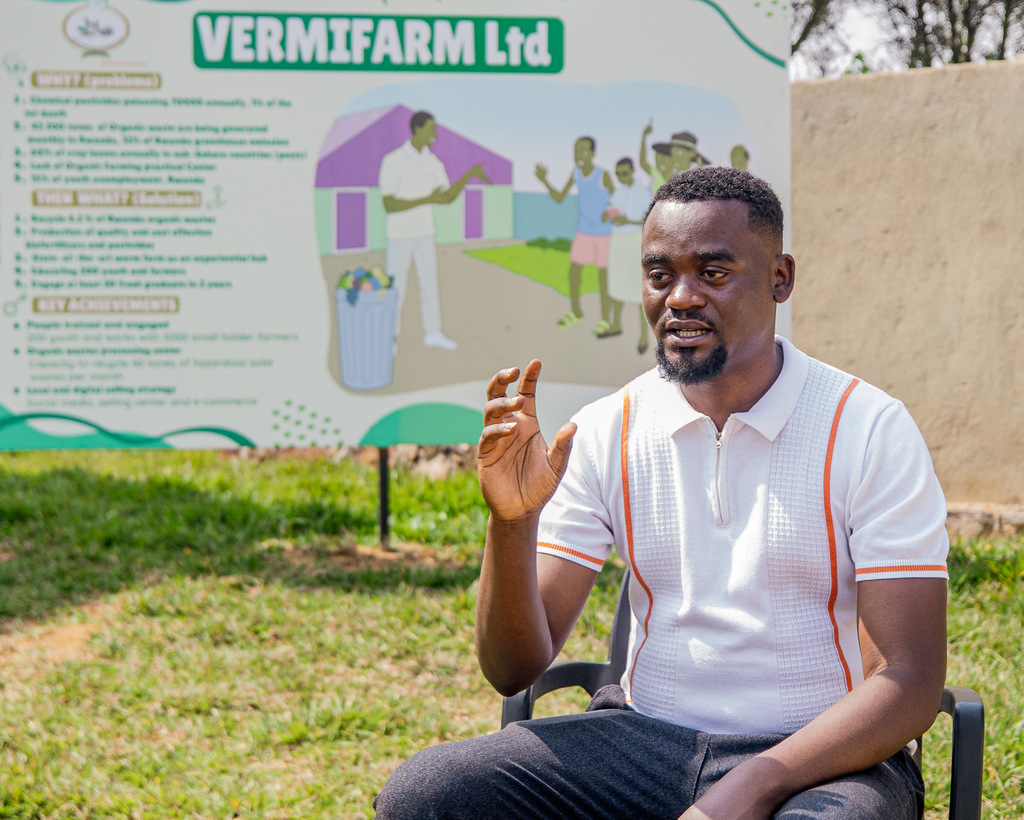
Vincent Sindikubwabo, a graduate in Environmental Science and Management from Belgium, is the founder of Vermifarm Ltd, a company that produces organic fertilizer and natural pesticides using earthworms together with decomposed food and crop residues.
He has developed a unique approach: producing both fertilizer and pest control solutions by harnessing the natural activity of earthworms.
The process begins with food waste collected and left to break down into small particles. These are then placed in specially designed structures where earthworms feed on the material. Within one to two months, the transformation produces organic fertilizer.
Speaking to KURA, Sindikubwabo explained: “When we prepare fertilizer and pesticide, we first place large stones at the bottom, then smaller stones, sand, charcoal, and finally decomposed waste. The earthworms feed on this mixture and transform it into powdered fertilizer. The pits are watered at least three times a week, and the resulting liquid serves as a pesticide while also acting as a fertilizer.”
Research he conducted revealed that Rwanda sends around 42,200 tons of waste to landfills every month. This motivated him and his team to recycle part of that waste into fertilizer as a contribution to environmental protection.
Earthworm sourcing
According to Sindikubwabo, they are usually sourced from animal manure, particularly cow dung, which contains worm eggs.
“We collect manure and place it in a controlled environment where worms develop. To produce real fertilizer, the worms digest the waste, and the result depends on what they consume. This is how we obtain what we call vermicompost—fertilizer produced by worms,” he explained.
He added that one kilogram of earthworms, containing around 2,000 worms, can produce half a kilogram of fertilizer per day.
Speaking to KURA, he highlighted that worms must be kept at a temperature between 20°C and 28°C. With the proper care, Vermifarm has built the capacity to produce 60 tons of fertilizer and 3,600 liters of pesticide every month.
Social impact and business growth
As his business expanded, Sindikubwabo made a deliberate choice to support vulnerable groups, particularly young mothers.
“I decided to help by creating jobs. I hired five permanent workers and also took in a group of 10 teenage mothers, aged between 15 and 20. We helped them establish kitchen gardens so they could access nutritious food. About 80% of them have now embraced family planning, thanks to the counseling we provided,” he said.
On revenues from the project, he explained: “If we process 60 tons of fertilizer and sell each kilogram at Frw 500, you can see the returns. Then consider the 3,600 liters of pesticide sold at Frw 2,000 per liter. In 2024 alone, we earned more than USD 87,000 in profits. This is clear proof that our business is viable.”
Despite this success, he noted the challenge of convincing people about the method:
“Some people still get scared when they hear our production relies on worms,” he admitted.
Advice to youth
Sindikubwabo encouraged young people to overcome fear and invest in agriculture.
“Imagine someone investing 50 million francs into fertilizer production using earthworms! That is not a decision many would take. But innovative ideas can help you reach your dreams faster. Learn from those who have made progress, seek knowledge that drives development, stay patient, and be bold enough to embrace agriculture,” he advised.